













































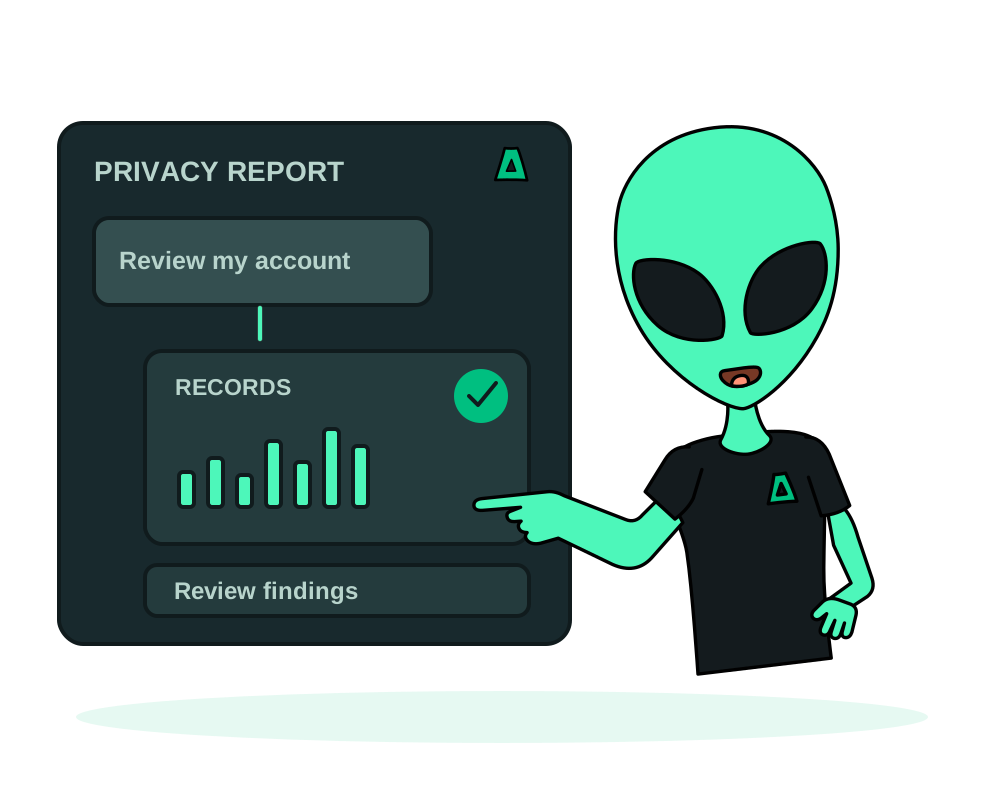
The Impreza account privacy report summarizes described data categories associated with your account. It combines measured counts and available date ranges with field descriptions, retention settings and notes about coverage.
Use it to ask informed questions about your account. It is not an independent audit, a complete export of your data or a certificate that nothing is stored.
Request the report through an authorized connection
Call impreza_privacy_report through your authorized Impreza MCP connection. The tool takes no arguments and requires read permission. It reports on the account behind that connection; there is no account ID parameter for inspecting someone else.
For an assistant, ask:
Read my account privacy report. Summarize the categories held, retention findings and coverage limits. Do not repeat identity hints or other sensitive details into the conversation. Do not delete or change anything.
Check generated_at so you know when the snapshot was produced. Treat the result as account information and avoid sharing the full report publicly, even though it does not return ticket bodies or stored secret values.
Read identity presence without assuming anonymity
The identity section indicates whether described fields are held and may provide a masked shape. Some contextual fields, such as country, can remain readable. Presence is not the same as a verified real-world identity, and a masked field is not evidence that the underlying value has been deleted.
Signing up without supplying an email remains compatible with the Account ID and recovery-token experience. A technical account email field may still appear in the system. Do not interpret a populated email indicator as a mailbox you can access or use it for password recovery. Keep your recovery token securely, as described in the Account ID signup guide.
No-email signup does not imply that support interactions, transactions, operational records or connection metadata cannot exist.
Inspect counts and date ranges
The records section describes categories and, where measurable for the account, their row counts and oldest or newest dates. It also indicates whether a category can contain identifying information or content.
Read scope alongside the numbers. Some categories are system-wide descriptions rather than rows attributable to one account. A missing count, date or category is not automatically zero. A query that cannot be measured is not proof of absence.
The IP-address section summarizes selected recorded connection information. It is not a scan of every log across the hosting infrastructure or the customer’s own server.
Interpret retention indicators carefully
For covered categories with a day-based window and a usable oldest date, the report compares that date with a configured or documented window. The current comparison allows a one-day margin for scheduled cleanup.
honoured: truemeans the available comparison passed. It is not a certification that every copy was erased on time.honoured: falseidentifies a comparison that needs investigation. Keep the category, reported dates and report timestamp for support.honoured: nullmeans that comparison is not available, for example because there is no timed window or no usable date. It does not mean the category is empty.
A category described as kept until deleted does not have an automatic expiry merely because the report mentions retention. The retention_not_honoured section highlights flagged categories; an empty section does not prove complete compliance across systems outside the report’s scope.
Review creation metadata and expiring access
The anonymous-account creation flow now retains its bootstrap creation IP for a specific window: 24 hours, followed by the scheduled cleanup. Inspect the report’s category and timestamp for the measured state. This policy does not describe every connection record, support interaction or log on your own server.
Anonymous MCP access credentials now have an expiry. Check the credential’s expiry and reconnect through the supported account flow when required; a lost connection does not erase the account or replace the Account ID recovery procedure. Keep expiration notices separate from the report’s data-retention indicators.
For host inventory, current hosted MCP and local MCP 0.48.0 or later leave SSH fingerprints out by default unless the dedicated tool is explicitly asked to include them. This reduces unnecessary identifiers in AI output; the provider you choose can still receive prompts and other returned information. Read the inventory privacy reference.
Separate measured findings from explanatory notes
The report names secret-related fields so you know those categories exist, without returning their stored values. This is not a reason to assume every configuration value or environment variable is encrypted, or that no other authorized interface can ever return sensitive data.
Third-party and available-action sections provide explanatory descriptions. They are not a measured traffic trace or a complete audit of what each provider received. Review the privacy policy and ask support about a specific route or category when needed.
Check the coverage boundary
The report uses a maintained ledger for Impreza’s own module and platform tables and a curated set of WHMCS core tables. It can report absent tables. This is not an exhaustive inventory of every upstream table, backup, external provider or historical log.
It does not inspect the files and logs generated by apps on your own server. Review those separately, using appropriate application tools and your own data-retention practices.
Follow up on a finding
If a category or retention result is unexpected, send support the minimum details needed to investigate: report timestamp, category and the relevant indicator. Avoid attaching the full report or copying identity hints unnecessarily.
Review unused credentials with the delegated access guide and unnecessary event destinations with the platform events guide. Reading the report itself does not revoke access, erase records or close the account. Choose each follow-up action deliberately and verify its result.