





















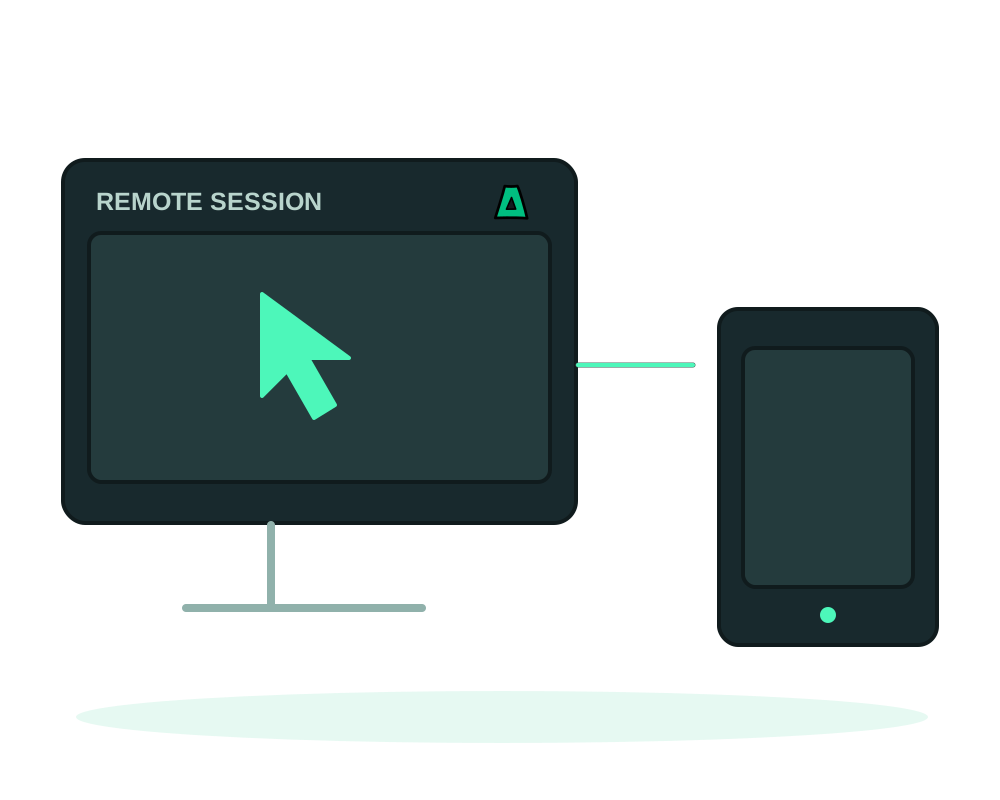
Host the RustDesk ID and relay services on your own offshore VPS. Clients can connect directly when network conditions allow, or use the configured relay. Configure each client with your server details and verify the connection mode and security before relying on remote access.
What you get
- Your own ID and relay services, with clients configured to use them
- End-to-end encrypted, with clients pinned to your server’s public key
- Desktop clients, with features and licensing checked for the edition you use
- Light: about 512 MB of memory and 2 GB of disk
Get it running
Pick a VPS with good connectivity
Resources are modest, but this is a relay: what matters is bandwidth and latency between you and the machines you connect to. Choose an offshore VPS in a sensible location for both ends.
Install it in one click
Install RustDesk from the catalog. It runs the relay and ID services rather than a website, so there is no hostname or certificate step. See how one-click installs work.
Point your clients at your server
Configure each RustDesk client with your server address and its public key. The key is what stops a client from being tricked into using someone else’s relay, so treat it as part of the setup rather than an optional field.
Set strong access on every endpoint
Give each machine a permanent password you generated, rather than relying on the short rotating code, and only where unattended access is genuinely needed.
RustDesk uses TCP and UDP ports for its ID, relay and connection services. This catalog deployment does not use the web-app hostname, HTTPS certificate or Tor mirror flow. Check the ports required by your configuration and expose only those needed.
A machine with a saved permanent password can be reached by anyone who has that password, at any time, with no one present to approve it. Use long generated passwords, set them per machine rather than reusing one, and remove access when a device is retired.
Running the relay yourself gives you control over that part of the connection path. Protect both endpoints, verify the client configuration and limit unattended access; hosting the relay does not secure a compromised client device.
Restrict access to the relay’s published ports
With a capable Impreza Agent, open My Apps → Advanced → App settings → Inbound access. Review the ports RustDesk publishes and allow only the public IPv4/IPv6 ranges that need each TCP or UDP service. Published ports start open; an unticked port remains open. Restrictions can exclude your own clients, so check the addresses used by both ends before confirming.
Wait for enforced, then test the actual direct and relay connections from allowed and disallowed sources. A saved or pending rule is not evidence that filtering is active. Agent 0.6.26+ is recommended; local MCP control requires impreza-mcp 0.52.0+. For changing client addresses, plan how you will update the ranges without losing access.
The allowlist filters new connections arriving from outside the server. It does not replace RustDesk keys, endpoint passwords or endpoint security, and Shield’s HTTP controls do not protect these raw ports. Keep an independent administration path and follow the inbound access guide for limits and recovery.
Recover the service and reconnect clients
For a supported deployment with the Impreza Agent online, use app inspection and maintenance, then test an actual client connection. Check direct and relay paths where applicable; a running container alone does not confirm that the required network ports are reachable.
Review app backups to Impreza S3 for the service configuration and persistent server key material. Protect private keys and verify the public key expected by clients after recovery. A server backup does not include files or settings on remote desktop endpoints.
For migration between compatible servers, review firewall rules, server address and client settings before switching users. Retain an independent way to administer the host while testing remote access.
Choose the recipe and plan your updates
The Impreza catalog offers an updated RustDesk recipe for new installations. A catalog update does not upgrade an existing app or convert its data. Review the version available in My Apps, back up the app’s covered data and follow the application’s supported upgrade path before changing an installed instance. Confirm the restored or upgraded app’s important functions before moving users to it.
For the installation flow and version shown at deploy time, use the app catalog guide.
Start now
Spin up an offshore VPS and install RustDesk from the catalog, or read the documentation.