Whether Offshore or Surface, we have it all, a lot of Server
options for various types of use!



















Main sales at Impreza Host,
get the solution that works for you


Update (2026): Impreza has grown a lot since this was written. We now run privacy-first, offshore hosting you can deploy by chat, with no KYC and crypto payment. Explore what we offer at impreza.host and in our documentation.
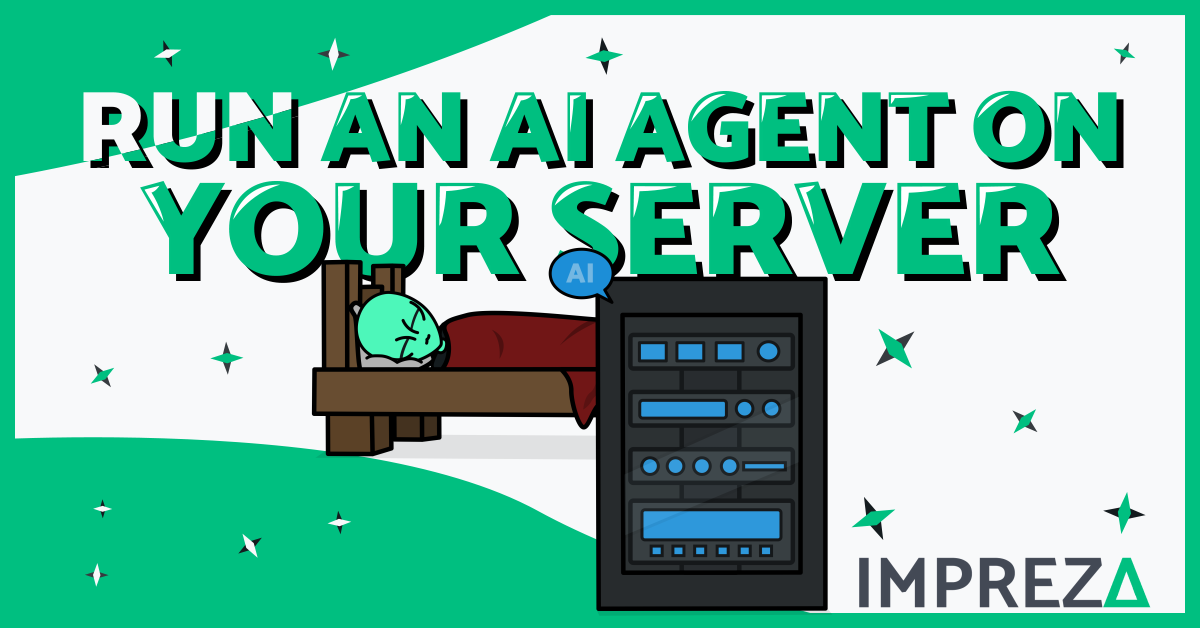
Autonomous agents stopped being a demo this year. People are running OpenClaw, Hermes, AutoGPT, CrewAI, n8n flows, and their own hand-built Python and Node agents around the clock, doing real work: watching inboxes, posting to channels, scraping and summarizing, calling tools, triggering on webhooks. The one thing they all share is that a laptop is a terrible home for them. A machine that sleeps when you close the lid cannot run something that is supposed to never stop.
So the standard advice is to rent a VPS, and every agent hosting guide on the internet stops right there. Pick a box, install your agent, set up systemd or PM2, done. They all skip the question that actually matters for this particular workload, which is not “where does it run” but “whose server is it.”
A static site is harmless if the server it sits on gets compromised or compelled. An autonomous agent is the opposite. Think about what you hand it to do its job.
It holds your LLM API keys. It often holds tokens for the channels and tools it touches: your email, your messaging, your repos, your files and it acts on your behalf without you watching, sometimes hundreds of times a day. And it accumulates a log of everything it did, which is a detailed record of your operations, your interests, and your patterns.
That is the most sensitive software most people will ever host, and the default is to run it on a box rented under a real name, with a card, on infrastructure in a jurisdiction chosen by accident. For a hobby bot that posts memes, fine. For an agent wired into your actual work and credentials, the question of who controls the underlying machine, and who could be made to hand over its contents, is not paranoia. It is the main risk, and the guides never mention it.
Three things, specifically.

Strip away the marketing and the useful properties are short.
The part almost nobody offers: a server that does not know your name. Specifically, signup with no KYC, payment in crypto, a jurisdiction you picked on purpose. Yet for a tenant that holds your keys and acts for you, this is the property that should come first — and still, it is the one the entire agent hosting category leaves out.
And one more that pairs naturally with agents: a private endpoint. If your agent needs to receive commands or webhooks, being able to expose it as a Tor onion service instead of a public IP means the control channel itself does not advertise where the agent lives or who runs it.
You deploy the agent the same way you would deploy anything else, and it inherits the privacy of the platform underneath.
For something in the catalog, like n8n, it is close to one click. For OpenClaw, Hermes, or your own agent, you deploy it as a container or straight from a git repo, and it runs as a long-lived service that survives reboots.
The server was signed up with an email and no KYC, paid for in any of twenty plus cryptocurrencies, in an offshore jurisdiction you chose. If the agent needs an inbound endpoint, you can publish it as a Tor onion service with a single flag instead of putting it on a public IP.
Because the platform is AI native, you also manage the agent the same way you talk to one: through an API, a CLI, and an MCP server, so deploying, restarting, and checking on it are calls you can make from your own tooling rather than hand-managed SSH sessions from whatever network you happen to be on.
Two honest limits, because this workload deserves straight talk. First, Impreza is private infrastructure with a deploy layer, not a turnkey agent host with pre-wired Telegram and Discord channels. You bring and configure the agent itself; the platform gives it a private, always-on home. Second, and this catches people: the privacy is in the infrastructure, not in the model calls.
If your agent calls a hosted LLM, that provider still sees the prompts. Running the agent on a server that does not know your name protects the server, the keys at rest, the logs, and your identity as operator. It does not anonymize the API calls the agent makes to a third-party model. Route those deliberately, or use a model endpoint you control, if that is part of your threat model.
Getting an agent to run 24/7 is the easy, solved part. Every guide and every host can do it, which is exactly why they all stop there. The decision that actually matters for an autonomous agent is the one they skip: it holds your keys, it acts in your name, and it runs while you sleep, so whose server it lives on is not a footnote.
Put your meme bot wherever. But the agent that touches your real credentials and does real work deserves a home that was never tied to your name in the first place. For that tenant, “whose server is it” should be the first question, not one nobody asks.
Don’t let your Passwords in the hands of third parties! Host your own Vaultwarden now and keep your stuff protected!
In need of a Privacy-Focused Server? Take a look at our Offshore Dedicated Servers to host your Brand anonymously!